
So, you’ve decided to go off grid with solar but you have no idea what size battery, inverter or panel array you need. Don’t worry, it may seem overwhelming to figure this out, but it’s not that hard. You just need to know a few things to get started.
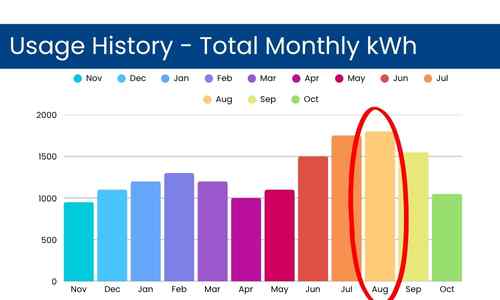
1. How many kWh of energy do you use in your peak month? (Look for the monthly bar graph on your utility bill)
2. What electric appliances could possibly be running at the same time?
When we get inquiries for our off grid solar systems, these are the 2 pieces of information we need to help our customers size their off-grid system correctly. If the customer already has an electric bill, we look at their previous 12 months of usage, shown as a bar graph month by month on their bill as total kwH by month.
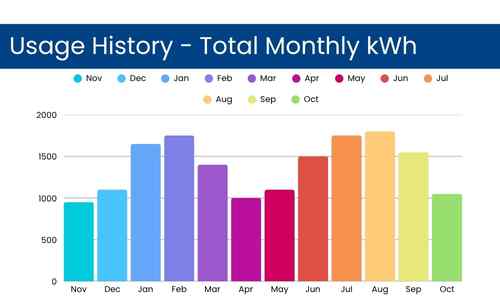
Then we look at the peak month, which is usually in the winter (when heat is running) or in the summer (when AC is running).
Keep in mind, we are sizing the systems to help our customers go fully off grid. Their goal is no more power bill. Since we can’t guarantee full sun every day of the year, we do recommend a back-up for when it’s rainy for a few days or super cloudy.
We take that peak number of kWh per month (1800 in the image above), and divide it by 30 to get the average daily kWh usage.
1800kWh / 30 = 60kWh used daily on average
This is how we decide what size battery is required for your off grid solar system so you’ll have a full day’s worth of power in your battery, so if it’s rainy, cloudy, or snowy, you can usually get through at least a full day (or 2 if it’s sunny) without having to use a generator or the grid as back up.
Yes, a bigger battery is always better, but more battery will cost you much more than installing a generator backup and we are usually working with customers that have a tight budget and still want to be totally off grid.
On average, when sized this way, our customers use their generator back-up about 10 times a year and spend $50-150 on fuel per year for that generator, depending on their energy consumption of course. If you’d rather spend an extra $10-$20k upfront on more battery, you do you.
We also program all of our generators with AIB PowerLink, which pairs your generator to your solar system. When the power is low, and no sun is out, the solar system sends a signal to start the generator, which turns on automatically, charges the battery bank to about 50% and turns off. Then the system waits for the sun (PV) to come back out and charge the batteries/supply your power. If it’s still raining the next day and there is no sun, the generator will start up again and then automatically turn off. Voila! You are able to go on vacation, and your solar system will operate fine on its own with no outages and no thawed meat in your freezer.
Let’s get back to sizing your system. Below is an easy 3-step guide to figuring out exactly what size battery, inverter and solar panel array you need to power your whole home 100%, off grid.
Using the sample kwh usage graph above, this home uses about 60kWh per day.
For that daily usage, we recommend a 60kW LiFePo4 battery bank. This would not be the same size if you are using Lead Acid batteries, as you can only discharge about 50% capacity. With LiFePo4, you have 100% capacity. (Lead Acids aren’t actually cheaper after all, and they don’t last even close to as long as LiFePo4 batteries).
Now that you know your battery size, what else do you need? Well, you still need an inverter to convert the DC power into AC power for your home, and a solar panel array to produce the energy from the sun. Let’s get into how to size the inverter for your solar system next.
This step requires some more calculations. Every household is unique in their usage so you can’t just look at the total kWh on your bill like we did for the battery. You have to know what wattage all of your appliances are, and how many could possibly be running at exactly the same time. Why? Because if your inverter is too small, you won’t be able to run everything at the same time without it turning off.
Let’s say your home has an electric oven, electric hot water heater, electric dryer, electric vehicle (EV) charger, microwave and all the lower wattage appliances like fridge, freezer, TV, computers, lights, power tools in the garage, etc.
What if you’re taking a shower while your spouse is cooking a turkey, the dryer is running, your car is plugged into charge and your 11yr old is heating up mac n cheese in the microwave? Can you estimate how many watts of power you’re pulling through the inverter at the same time?
Let’s calculate it:
Electric Oven: 5,000 watts/hour
+
Electric Hot Water Heater: 6,000 watts/hour
+
Electric Dryer: 5,000 watts/hour
+
EV Charger: 12,000 watts/hour
+
Microwave: 1800 watts
+
Lights, TV, Computers, Fridge, Freezer: 1,500 Watts
+
Total Power Pull: 31,300 Watts
Oh wait, I almost forgot, your 5 ton AC unit is running too (It’s August).
Actual Power Pull: 37,300 Watts!
Electric appliances (especially heat driven or EV chargers) keep your usage sky high. If this is the case, we would put you in a 48kW split phase (120/240v) inverter. Usually if you have a standard residential home, 2,000+ square feet with all standard electric appliances, you will need a 48kW inverter.
Why? A 48kW inverter is equal to a 200amp breaker panel, which is another way to know what size inverter you need. If you have a 200amp breaker panel, your breaker would trip if you pulled more than 48kW, so the 48kW inverter would be the one that keeps you at the same comfort level you have now.
If you have a 100amp breaker panel, the 24kW split phase inverter would be the right fit. If you have a 50amp breaker panel, a 12kW inverter would be fine. And for tiny homes, RVs and small cabins that don’t use a lot of power, you can go as low as 6kW or in very low usage cases, even lower, on your inverter.
A single phase inverter will only be able to run appliances that use 120v. Split phase inverters can run 240v too, like your electric dryer, 240v mini split or a 240v well pump. All of our solar systems at AIB Off Grid come with split phase inverters, even the 6kW because we designed our smallest system for off grid cabins, and they usually have a 240v well pump. But most 5-6kW inverters on the market will be single phase (120v).
Now that you know what size battery and what size inverter you need, it’s time to figure out how many solar panels you need to produce energy for your solar system.
The number of panels you need and can depend on a few different factors.
1. How many hours of full sun do you get in your geographic location?
Go go https://globalsolaratlas.info/map and enter your location. Look at the colored legend which shows your annual kWh production. Take that number (1800 for example) and divide by 365 to get your daily peak sun hours (5).
2. How much power do you use during the day?
In the sample above, we are using 60kW per day. You need to either look at your power bill to see how many kWh you use per month and divide by 30 OR if this is a new build or a totally off grid cabin, add up the watts of each appliance multiplied by the number of hours you use them daily.
3. What size is your inverter?
Remember, if you have a 50amp breaker panel, you need at least a 12kW inverter. 100amp breaker panel = 24kW inverter and 200amp breaker panel = 48kW inverter.
Continuing to use the sample above, we are pairing a 60kW LiFePo4 battery bank with a 24kW Split Phase Inverter.
Based on the inverter max PV input (check the technical specifications of your inverter spec sheet), we can put up to 24kW of PV power (solar energy) through it. So we know that the MAX amount of solar panels has to equal 24,000 Watts or less. You can always do less and add more later if it’s not enough.
If you’re using 60kW per day and you have a 60kW battery bank, you want to bring in enough solar energy to both power your daytime usage (so you save the battery for the night) and charge your battery fully. You probably use about 30kW during daylight hours, and you have a 60kW battery bank so we would aim to produce 90kW with an array.
30kWh + 60kwH = 90kwH
Now you need to figure out how many hours of full sun will be hitting your panels. We service the Ozarks, which get about 6 full sun hours a day. When multiplying the size of the solar array by 6, to get the average amount the array will bring in each day. You should use the number of peak hours of sun for your area.
(Here’s how to do that: https://globalsolaratlas.info/map)
For example, a 24kW solar array, multiplied by 6 (24*6) will bring in about 144kW per day. That’s a bit more than is needed for this 60kW battery, 60kW of daily energy consumption and 24kW inverter.
But a 15,000-watt solar array x 6 would be exactly 90,000 watts of PV per day. So that’s the size array we would recommend. Enough to supply your power during sunlight hours, and a fully charged battery when the sun goes down. Perfect.
So that’s how you figure out what size solar system you need to power your home off grid. In this example, the home is using about 1800kWh in their peak month (AC season), which translates to 60kWh per day. The right size system for to take this entire home off grid would be a 60kW LiFePo4 Battery Bank, 48kW inverter and a 15,000 Watt Solar Panel Array.
If you’d prefer us to do the calculations for you (or if you want a free estimate), send us an email at sales@AIBOffGrid.com.


